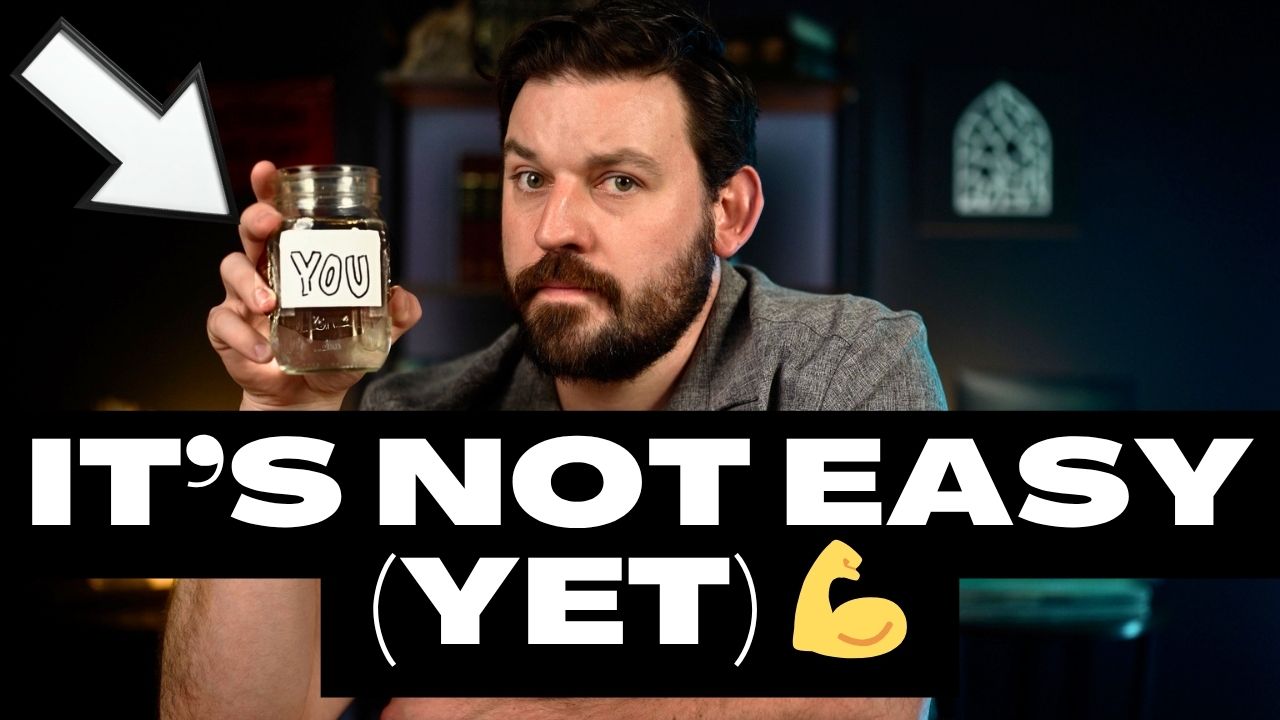
ALERT: Leaders Aren't Healthy | Start This ASAP
May 24, 2026YouTube Version (If You'd Rather Watch 👉) https://youtu.be/znp4ms_qLrY
--
Why do I keep getting sick?
Why do I constantly feel tired?
Why am I in pain all the time?
Why am I having trouble sleeping?
Have you ever felt that way?
What about burnout, anxiety, high blood pressure, self-medicating, chronic stress, depression, loneliness…
Sound familiar?
Research shows that leaders' mental, emotional, and social health is statistically speaking in really, really bad shape.
Recent studies reveal that approximately 70% of leaders report feeling overwhelmed by work demands.
1 out of every 4 executives reports symptoms consistent with clinical depression.
Up to 63% of senior business leaders suffer from stress and anxiety directly connected to the responsibilities of their roles.
Nearly half of all CEOs report feelings of loneliness and isolation, with 61% stating it directly impacts their performance.
Gallup data shows that leaders experience 7% more stress, 12% more anger, and 11% more sadness in the workplace compared to the individuals they lead.
Over half of all leaders (56%) report feeling burned out.
The research also shows how this results in an increase in cardiovascular risks like high blood pressure, cholesterol issues, and an overall risk of heart disease.
It leads to issues like chronic sleep deprivation, weakened immunity, and Musculoskeletal Disorders.
Do you get the picture?
Leadership can be detrimental to your health if you aren’t paying attention.
So, what do we do about this?
You know, I’ll be fully transparent with you.
This is a reality I’ve had to face firsthand over the years and one that I’m facing right now.
I know how hard this is.
Over the years, I’ve had seasons where I’ve worked through stress, anxiety, depression, loneliness, sleep issues…
Not too long ago, I got bloodwork done, and it was a bit of a wake-up call to take my health a little more seriously.
I started taking some supplements, like Vitamin D, B-complex, and magnesium, to support energy, mood, and sleep.
Even right now, my leadership role requires a lot of meetings and writing.
There are some days I’m just painfully sedentary, and I’m feeling it.
My point is that I get the struggles.
My first leadership position was almost 15 years ago, and as my leadership responsibilities have increased over the years, I’ve had to become increasingly intentional about my personal health.
Maybe you’re experiencing some of those same challenges.
It takes a lot of intentionality to be a healthy leader.
This is particularly true in turbulent times when the pressure and responsibility start to rise.
It’s so easy to see your mental, emotional, physical, social, or spiritual health start to slip.
It’s a fight that you can’t ever give up on.
And here’s why this really matters so much and why we desperately need to talk about this: Leadership is about serving people.
A leader cannot serve people effectively from an unhealthy place.
You can’t drink from an empty well.
You can’t give what you don’t have.
If true leadership is all about serving and giving, then a leader has to prioritize their health.
It’s not selfish.
It’s like a soldier conditioning themselves for war.
It’s about being responsible for your own well-being in order to be responsive to other people’s well-being.
That’s a mission every leader should take very seriously.
So, let’s talk about it.
First, let’s talk about the root of the problem.
After that, we’ll get tactical and discuss three strategies that will help you grow, last, and thrive as a healthy leader.
That is, after all, what this community is all about.
Let me demonstrate the problem many of us are experiencing.
(You can watch the following illustration on YouTube but I've included a summary below)
This is you.
You have input and output.
People are put in leadership to get results, right?
The quality of your leadership is judged on the basis of your output.
How you invest and develop, the results you get, the quality of your decisions, the way you can grow things, the quality of your communication, the energy and passion you bring, you get the idea…
So, naturally, most leaders focus on just that, output.
But what happens as you output?
You get depleted.
Eventually, you run dry.
Unless you can fill yourself back up, right?
You need input.
Now, there are two different types of input: Healthy and unhealthy.
What happens if you choose healthy?
You get greater output.
Everything continues to flow as it should.
But what happens if you choose unhealthy input?
Well, it’s going to clog up your system.
You’re going to find that while you feel like you’re getting input, it’s going to render your output non-existent.
Nothing is going to be able to flow out of you.
The more you turn to unhealthy input, the more stuck and unhealthy you become.
In other words, if you don’t find a constructive way to fill your tank up, you’ll start looking for destructive ways to fill your tank up.
HEALTH FABLE:
I once saw a meme about a doctor and a patient.
The patient said, “I don’t know why, but I feel depressed.”
The doctor asked, “Well, do you eat healthy?”
“No,” the patient answered.
The doctor said, “Okay, well, are you staying hydrated?”
“Not as much as I should,” the patient responded.
“Do you exercise?”
“Not really.”
“Do you get outside in the sun much?”
“No.”
“Do you go out with friends from time to time?”
“Not often.”
“How much sleep do you get?”
“Not enough.”
“How much time do you spend on screens?”
“A lot.”
“Do you drink alcohol?”
“Yes”
“How much?”
“Too much.”
“Do you have good work/life boundaries?”
“Nope.”
The doctor then says, “Ah, I see what the problem is.”
“What?!,” the patient asks.
The doctor holds up a mirror to the patient.
The truth is, most of the time, our problem is staring back at us in the mirror.
We choose to use unhealthy input instead of healthy input.
If you aren’t doing the basics, nothing else will really matter.
Look, I understand that turbulent seasons can make it feel like a genuine fight just to do the basics, but that’s where we need to take an active approach to our health rather than a passive one.
So, let’s get tactical about this.
Let me give you a handful of quick and powerful strategies that might help you win this fight.
STRATEGY #1: SHIFT YOUR WAKE WINDOW
Back in the late 1990s, Roy Baumeister proposed the Ego Depletion Theory, which suggests that self-control and willpower are finite resources that can be depleted over time.
According to the theory, engaging in tasks that require self-control—such as resisting temptations, making decisions, or exercising discipline—uses up mental energy and reduces our ability to exert self-control in subsequent tasks.
Think about it.
Have you noticed that most unhealthy habits happen at night?
It’s not a coincidence; it’s because you’re tired.
Your willpower and motivation are running low and need recharging.
That’s why going to bed early and rising early is so powerful.
You’re organizing your day to optimize around your motivation and willpower tanks.
You wake up with the most self-motivation you’re probably going to have all day.
So, take advantage of it.
This leads us to our next strategy.
STRATEGY #2: CREATE YOUR INPUT STACK
Once you’ve shifted your wake window, the next strategy is all about how you use that new morning time for healthy input.
For instance, I wake up at 4:40 am every morning.
I go to the gym, when I get home, I pour my coffee, and I spend time reading the Bible and my devotional, praying, and then I journal.
All of that happens before my family wakes up and the day starts.
It’s life-giving to me.
If I rolled out of bed at 8:00 am without having worked any of my healthy input stack, I would be grossly unprepared to handle the day.
Trust me, my wife can tell you that Zach without his morning routine is not a happy or helpful Zach.
I’m grumpy, and I feel unprepared to give of myself in the way that the people in my life need.
It feels more like I’m being attacked by the day rather than me attacking the day.
I’ve got to have my healthy input before I’m ready to output.
And for me, that means I need time to exercise, I need coffee, I need time with God, and then I need to process everything on my mind through journaling.
That’s what works for me.
Figure out what works for you and make it a daily habit.
STRATEGY #3: TAKE A MONTHLY RETREAT
If your daily habits of healthy input are the trickle charge that keeps you going, retreats are like your jump-start.
For years, I heard the advice of getting away and never acted on it.
For one thing, I felt guilty leaving my wife with the kids while I went off to recharge and refocus.
But that changed many years ago, when both my wife and I realized that the demands of life and leadership were too great for me to ignore this habit any longer.
She looked at me one day (I probably was looking and acting like a shell of myself) and she said, “I think you need to go to the mountains.”
I didn’t realize how deeply I needed to get away to recharge and refocus until that very first retreat.
It was just one night, just a little over 24 hours, but wow, I came back a changed man.
All the noise went away, and I could finally breathe again. I could finally think clearly.
Things that felt offline started to come back online.
I came home a healthier husband, father, and leader.
From then on, my wife and I were both convinced that this needed to be a monthly habit for me, at least during turbulent times.
This habit is especially important if you’re an introvert like me.
That means you gain emotional energy from being alone.
If that’s the case, you should 100% implement this strategy as soon as you can.
It definitely helped me become much healthier in my life and leadership.
No matter where you are in your journey.
I hope you realize just how important your health is as a leader.
I’m cheering you on, and I’m also praying for you. I pray over this community every day.
As always, keep fighting the good fight.
GET MY FREE LEADERSHIP RESOURCE LIST
Stay connected with leadership updates!
Join our community to receive the latest content and updates.
We hate SPAM. We will never sell your information, for any reason.