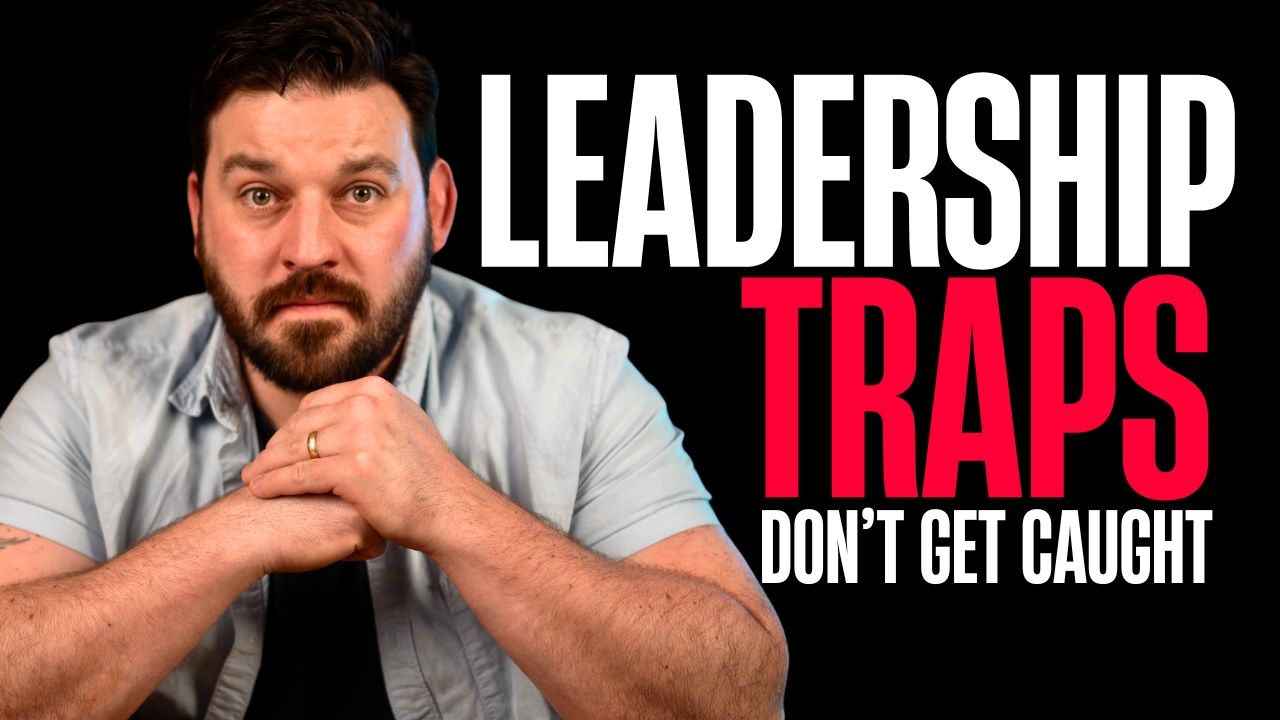
3 Hidden Leadership Traps That Are Holding You Back
Mar 28, 2026YouTube Version (If You'd Rather Watch 👉) https://www.youtube.com/watch?v=-zS6oZhQkjU
Over the years, I’ve seen myself and other leaders get caught in three prevalent leadership traps that hold back growth and, in extreme cases, even bring leaders down completely.
It’s really nasty stuff, and I don’t want you to be a casualty of these traps.
So, in this episode, we’re going to get them all out on the table, and we’re going to talk about how we can fight back.
Because here’s the problem: If we fall for one of these traps, it’s extremely difficult to get out, and it can do a lot of damage.
I don’t think either of us wants to go down that rabbit hole.
But more than that, we both want to be the best leaders we can be, right?
Well, we’ll never realize that if we don’t address these three things first.
And look, I’m living this right now.
I’ve experienced all three of these leadership traps, and I am actively in the trenches fighting back.
So, this isn’t theory for me.
This is reality.
It’s going to be a good conversation.
Okay, let’s jump in.
TRAP 1: DOPAMINE JUNKY
Recent studies reveal that approximately 70% of leaders report feeling overwhelmed by work demands, and nearly 30% exhibit symptoms of workaholism.
That’s 1 out of every 3.
This compulsive work behavior can be particularly pronounced in leadership roles, where the pressure to deliver results can become a driving force for overcommitment.
But the pressure that leaders experience is just the start.
The neurological basis for this behavior is closely tied to the brain's reward system, particularly the role of dopamine.
Engaging in work provides a sense of accomplishment, triggering dopamine release, which reinforces the behavior and creates a cycle of dependency.
Leaders often seek this "dopamine high" as a source of motivation, leading to a growth addiction—where the drug of choice is success, compelling them to chase ever-increasing goals and results.
It’s a cycle.
The pressure leader’s face is the catalyst that begins the cycle.
And the dopamine hits are what keep the cycle going.
But there’s more…
For many leaders, getting results is all about security and validation.
The belief that their worth is tied to their productivity can drive them to work excessively, often at the expense of their health and well-being.
This results-oriented mindset can foster an environment where overwork is normalized and even celebrated.
A survey conducted by the Harvard Business Review found that 61% of leaders believe that working long hours is essential for their success.
Here’s the crazy part.
Leaders who exhibit this behavior are at a higher risk for physical and mental health issues, including burnout, anxiety, and cardiovascular problems.
So, in other words, this trap is quite literally killing over 60% of leaders right now.
A study in the Journal of Occupational Health Psychology found that workaholic leaders are 2.5 times more likely to experience burnout compared to their peers who maintain a healthier work-life balance.
Moreover, workaholism can negatively impact team dynamics, as leaders may inadvertently promote a culture of overwork, leading to decreased morale and productivity among their team members.
These ripple effects can undermine organizational effectiveness, as teams become strained and disengaged.
In other words, it’s a trap.
So, let’s ask the critical question: Are we paying attention to this?
Are we on the lookout for this?
I’ll be 100% transparent with you that I’m hyper-aware of this trap at the present moment.
For the longest time, I focused solely on input, learning, and growing as a leader.
But now I’m transitioning into more output.
I'm working harder in the next leg of my life to invest in and serve other people.
But that takes a lot.
For instance, I’ve had to work hard over the last few months to get this leadership community off the ground.
You’d think you can just hit record and talk about leadership, but no.
It’s a lot of work.
I’ve had to learn a lot of new skills.
I knew going into this that I would need to put up safeguards.
One of the biggest concerns I had was social media.
I know social media is addictive.
For the longest time, I wasn’t on social media, but now I am.
I want to serve people like you, but I don’t want to become a casualty of what social media can do to you, you know?
So, before I even started this leadership community, I actually bought this device here.
It’s a brick.
It can lock away the apps I use for work at times when I don’t need to be working.
If things get out of hand, I know that I have this device to reign things back in.
I know people who put time limits on their devices or password-protect certain things.
There are all sorts of ways you can fight back, but the most important thing is to just be aware of it and have tools in your tool belt to break the cycle if needed.
You’ve got to understand that the leadership “current” is trying to slowly drift you into this trap.
If you are oblivious to it, then it’ll take you.
Don’t let it.
You have to put in safeguards that keep you from drifting.
Find some form of accountability and let it ground you.
TRAP 2: THE “MICHAEL SCOTT”
If you haven’t seen the TV show “The Office,” then I’m afraid that there is no hope for your leadership… (kidding).
If you haven’t seen “The Office,” Michael Scott was the classic boss, played by Steve Carell, who just wanted to love and be loved by his employees.
He viewed the office as his family.
His employees, however, did not.
They saw him as the boss.
This, in so many ways, was the joke of the entire show.
Michael tried so hard to connect with his coworkers, but they just wouldn't have any of it.
It was hilarious, but it was also kind of heartbreaking at times.
He wasn’t invited to the parties or the after-work hangouts.
Nobody wanted to eat lunch with him or laugh at his jokes.
He was the boss.
Time and again, you see Michael isolated and lonely.
It’s kind of pitiful, to be honest.
Leaders often have to deal with this “Michael Scott” dynamic.
They might love to have a meaningful relationship with their team, but the dynamics between leader and team member can often make that extremely challenging.
What if you have to talk about poor work performance, deny their time-off request, or be the bearer of bad news?
What if you have to make a hard leadership decision that you know everyone is going to hate?
What if morale is low?
Does that make it easy to go grab a beer after work, let your hair down around them, or do life together?
No, it’s hard.
Not to mention, a lot of people have a very negative view of authority.
They don’t want to feel controlled or told what to do.
The leader often becomes the scapegoat or the elephant in the room.
If this goes unchecked or unchallenged, both the leader and the team members will relationally drift, disconnect, and it will inevitably become a transactional relationship.
That’s when you get the boss-and-employee vibe.
And let me tell you something, a transactional team is a sad team. It’s no team at all, really.
I know a lot of people may disagree with me on this.
But I don’t care, I believe that the best teams are relationally connected.
You lead your team like a family.
Functional families are not transactional.
In so many ways, the natural, unchecked progression of leadership is toward a transactional approach.
It’s the cold clock-in, clock-out approach.
It’s awful.
Team members hate it.
And leaders hate it.
It leaves them feeling isolated and lonely.
But you know, here’s the trap in all of this.
The trap is to believe the narrative that leadership has to be lonely.
It doesn’t.
Sure, it can feel like that at times.
Sure, it can naturally drift in that direction if unchecked.
But it doesn’t have to.
As I said, I’m a pastor, so I hope you’ll forgive my occasional tangents on things.
But think about it this way.
Theologically speaking, God is at the top, right?
He’s THE leader.
He’s THE “top dog,” as they say.
God isn’t lonely.
The Bible reveals a God that is in perfect community.
Zero loneliness.
So, personally, I don’t believe it’s supposed to be lonely at the top.
If you’re lonely in leadership, it’s because you fell for the trap.
You bought the narrative.
And look, I understand, I've had seasons where I almost fall for it too.
Even now, I can feel that way.
I can start to believe that I can’t have a meaningful relationships in my role.
But it’s not true, and we have to fight back.
I feel like I can speak confidently here because I work with my closest community.
I work with my closest friends and even family, and while it’s not always easy, it’s possible.
Now, is loneliness a dynamic I struggle with more in leadership than I did before?
For sure.
There are certain decisions I have to make or dynamics I have to navigate that can feel lonely at times.
But I'm not a lonely person.
I still have meaningful relationships with my team because I fight really hard for that.
Don’t fall for this trap.
Don’t buy the narrative.
Don’t play the victim.
You might say, “But Zach, you don’t understand, I’ve been burned by people.”
Yeah, me too.
100% chance you get burned relationally as a leader.
You’re going to have people walk out on you, lie to you, betray you, hurt you, call you nasty things…
That’s the reality of leadership, my friend.
And you’re going to be tempted to shut down on people. Not open up relationally. Stay private. Stay closed off.
But deep down, you know that's not the solution.
Something inside you is thinking, “Hey, if I don’t let people in, I’ll never get hurt.”
But that’s foolish.
That’s like saying, “Hey, there’s a chance I may get into a car accident, so I’d better not drive at all.”
You see how crazy that is, right?
That’s not how life works.
You can’t live that way.
So, you have a choice.
Are you going to be the victim and close yourself off relationally because of that, believing the crap narrative that leaders are lonely?
Or are you going to suck it up and keep fighting for healthy relationships?
You know, Jesus had people beat the snot out of him and spit in his face and call him nasty things, but he still went to the cross and laid down his life for those same people.
Just because you get relationally hurt as a leader doesn’t mean that you give up on relationships.
Look, I’ve got some painful experiences.
Trust me.
But I refuse to close my heart off because of those experiences.
That’s not what a leader does.
Now, we could have a whole other conversation about relational boundaries within leadership.
But that’s an entirely different conversation for another day.
In fact, stay tuned, because there’s an episode coming down the pipe on that.
Let’s turn to the third trap now.
TRAP 3: LOSING THE HOME FRONT
I’m sure you’ve heard this expression.
It’s a wartime expression referring to a military losing public support, morale, and political backing for a war, making it impossible to continue despite military capability.
There are countless examples of the "home front" being vital to victory.
During World War II, countries like the United States and Britain recognized the necessity of winning the home front to ensure a successful war effort.
Propaganda campaigns, such as the iconic "Rosie the Riveter," encouraged women to join the workforce and support war production.
The home front's contribution was crucial; factories operated at full capacity, and citizens were encouraged to save resources and buy war bonds.
The success of these initiatives demonstrated that a strong, united home front could significantly bolster military efforts abroad.
In contrast to WWII, the Vietnam War highlighted the consequences of losing support on the home front.
As the war dragged on, public opinion shifted dramatically against U.S. involvement.
Protests, demonstrations, and widespread dissent reflected a growing discontent with the war, which ultimately pressured the government to withdraw troops.
There’s obviously a lot to be said about the controversial nature of the Vietnam War.
But I think the important thing to remember is that the US lost the Vietnam War because we lost the home front.
You see the same pattern in the American Civil War: the concept of "the home front" became a focal point of both the Union and the Confederacy.
Families left behind faced challenges such as economic instability, loss of loved ones, and the direct impact of war on their communities.
The emotional toll on families and the struggle to maintain daily life underscored the importance of home front morale.
One of my wife’s favorite movies is "Little Women."
She watches it every year around Christmas.
It’s funny, in high school, I went out for theater, and I remember being so disappointed when I found out we were doing a play called “Little Women.”
But I remember I got the role of Mr. Brooke, and after reading the script, I realized that it wasn’t actually that bad.
In fact, it tells an important story.
It was based on a classic novel published in 1868.
It follows the lives of four sisters as they grow from childhood to womanhood during the American Civil War.
It’s a fascinating window into what the home front of wartime looks like.
As someone who tends to focus on the war front, it’s quite moving to see what winning on the home front looks like and how the two need to work together.
And that’s why I bring this up.
There’s an important leadership lesson in all of this, or leadership “trap,” I should say.
The leadership trap is to put all of our energy into the war front and completely miss the home front.
We can’t win in leadership if we lose on the home front.
Look, I’ve got a wife and four kids.
That’s my home front.
Leaders fight on both sides: the war front and the home front.
That’s the only way to win this thing.
If I lose at home, I lose.
Period.
Even if I’m winning at work.
Even if I’m winning as a leader.
If I lose the home front, it’s game over.
Pack up and go home.
And the opposite is also true.
If I win the home front, the war front gets a heck of a lot easier.
And not just easier, but more meaningful.
I don’t know about you, but I don’t want to lose my wife and kids in the war.
I want them to thrive.
I want a future with them in it.
We can’t fall for this trap that says the war front is more important and the home front can be ignored.
Do you know how many broken families I’ve had to sit down with as a pastor who are falling apart because of this home front trap?
Too many to count.
It’s tragic.
Listen, your leadership isn’t just needed on the war front.
You’re needed at home.
Don’t fall for the trap.
As I say every week (and maybe today has a little extra weight to it)…
Keep fighting the good fight.
GET MY FREE LEADERSHIP RESOURCE LIST
Stay connected with leadership updates!
Join our community to receive the latest content and updates.
We hate SPAM. We will never sell your information, for any reason.