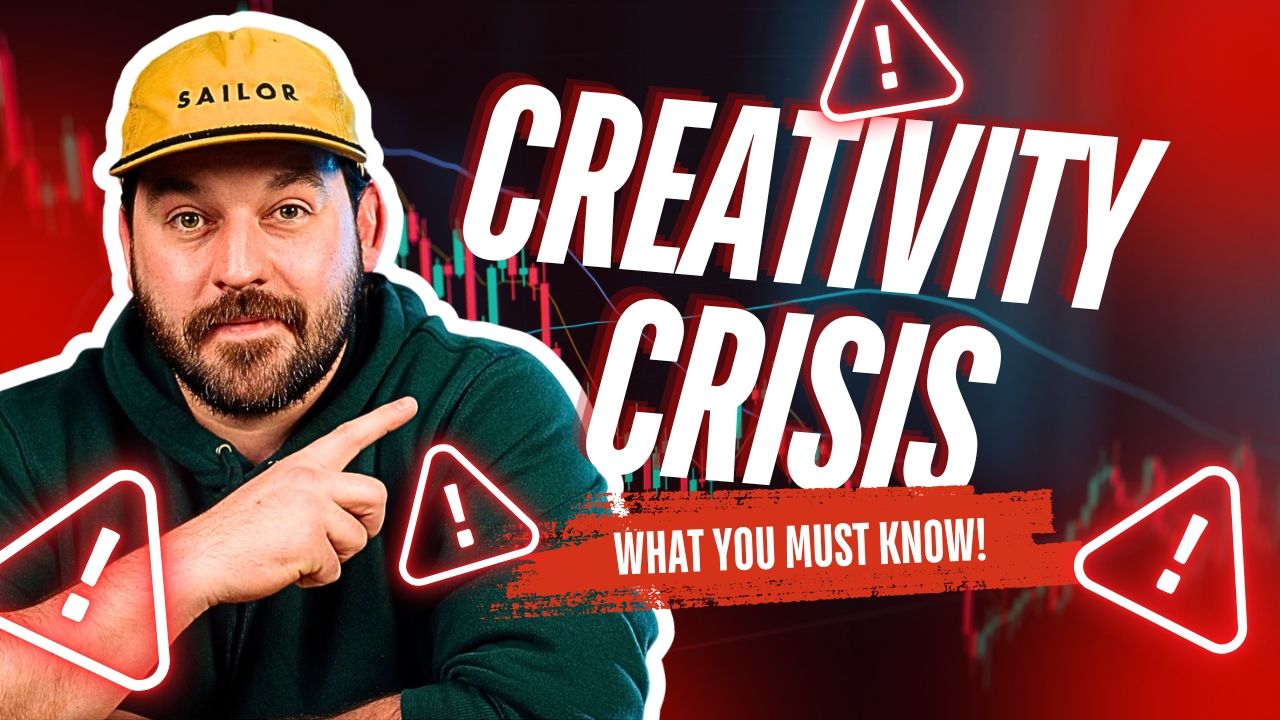
Your Creativity Is Disappearing—Here's Why
Feb 14, 2026YouTube Version (If You'd Rather Watch 👉) https://www.youtube.com/watch?v=XuR08PDB4Rk
In the 1950s, an American psychologist named Ellis Paul Torrance noticed something off in American classrooms.
He felt teachers favored the calm, book-smart type of students and often overlooked the kids with energy and big, creative imaginations.
These kids were often viewed as the “bad kids.”
Torrance didn’t think so.
He felt that they were misunderstood.
So, in 1958, Torrance developed the gold standard “Torrance Test of Creative Thinking” and devoted the rest of his life to studying creativity.
What Torrance found was remarkable.
He found that the kids with more creative ideas in the initial tests were the ones who actually became the most accomplished later in adulthood.
Torrance proved that creativity is an indicator of future success, reinforcing the need to encourage creativity rather than stifle it.
But that’s not all.
Let’s fast forward nearly fifty years to 2010.
A researcher at the University of William and Mary analyzed 300,000 Torrance Test scores dating back to its origin in the 1950s.
She found something.
Something alarming.
Something we need to pay attention to.
She found that beginning in 1990, creativity scores began to plummet.
Marking the beginning of what is now known as the “Creativity Crisis.”
And yes, scores continue to drop.
And no, this is not just limited to the US.
We’re observing this on a global level.
There are numerous influences involving the educational system, technology, cultural and parenting shifts, economic pressures, the list is endless.
However, most experts attribute the decline to really just three core factors.
CAUSE 1: REDUCED UNSTRUCTURED PLAYTIME
Before you check out, thinking that this cause only applies to children, think again.
It may start in childhood, but it’s arguably even more of a problem within adults.
So, I was homeschooled during my childhood.
I would usually finish my chores and homework pretty early in the day.
Sometimes even before noon.
And then I would have an entire day ahead of me to be filled.
Now, when I was growing up, I didn’t have devices.
There were no smartphones, and until around middle school, I didn’t even have access to video games.
We had a TV, but I don’t recall that we watched it much. Certainly not throughout the day.
Now, you may be wondering. Well, what did you do?
Well, I spent a lot of my time doing something really quite strange these days.
I played.
You know, like with toys, and sticks, and mud, and stuff.
I built forts.
I whittled wooden pieces and made swords and small trinkets.
I even tried making a chair one time in the 5th grade, which really didn’t work out too well.
I invented games.
I used my imagination.
I could spend hours and hours playing.
This was especially true when my parents would lock the door so my siblings and I couldn’t come inside (brilliant parenting strategy by the way).
Suffice it to say, I got pretty good at “unstructured playtime,” as they call it.
Looking back as an adult, I realize how healthy this was, and now I can thank my parents for locking all the doors.
Research shows that unstructured play is essential for fostering creativity, problem-solving, and imagination.
I don’t think I have to sit here and convince you that children are getting less of this than they used to.
We all know it.
But here’s the thing: There’s a myth out there that unstructured playtime is just for kids.
It’s a lie.
Adults need this just as much; it just looks a little different.
Some adults call it a hobby, recreation, or leisure.
But even those things are still highly structured.
What I want to encourage you to look for is unstructured time.
There’s a difference.
So, what does unstructured playtime look like for an adult?
Well, there’s a word for it.
You’ll only find it in the Southern slang dictionary.
Sorry, I was born and raised in the South.
It’s called “piddling.”
Sometimes adults overcomplicate this, okay?
Piddling is all about no agenda, no structure, just time spent piddling with things and letting your mind wander.
Give it a try.
CAUSE 2: INCREASE IN PASSIVE SCREEN TIME
In 2025, the average person worldwide spends approximately 6 hours and 45 minutes on screens daily, accounting for nearly 40% of their waking hours.
Daily usage varies by age: Gen Z averages about 9 hours, teenagers 7 hours and 22 minutes, and children aged 5-8 over 3.5 hours.
Go check your screen time on your device and see where you’re at. It’ll probably shock you.
Here’s the thing about screen time…
While it’s passive, it’s still focused.
Meaning, we think we’re just resting when we’re passively engaging in screen time, but it’s actually quite mentally fatiguing.
So, not only is it choking out nearly 40% of our waking hours, but it’s also leaving us exhausted for the remaining hours of our day.
That’s going to harm our creativity.
And there’s even more going on under the surface of this.
We’ll get to that in just a minute, but first, let’s quickly touch on the third cause.
CAUSE 3: INCREASINGLY OVER-SCHEDULED LIFESTYLES
There’s actually a lot of research coming out on this, particularly in adolescents.
Our over-scheduled lifestyles are leading to higher rates of depression, anxiety, anger, sleep deprivation, and burnout.
That’s not innocent.
That’s a problem.
Particularly, for creativity.
How are you supposed to be creative in that kind of intense environment?
We know that creative work is highly energy-intensive.
It consumes significant mental and physical resources to form new neural pathways.
This just isn’t going to thrive in an overpacked lifestyle.
But there’s another reason why this is killing our creativity.
In fact, it’s something that all three of these causes have in common.
All three causes contribute to a decrease in boredom.
Or put another way, all three causes stem from a desire to avoid the discomfort of boredom.
Søren Kierkegaard said, “It is very curious that boredom, which itself has such a calm and sedate nature, can have such a capacity to initiate motion.”
He’s right.
The question is, what is it initiating?
Research shows that boredom is actually the root of a lot of wonderful things.
At the top of the list is creativity.
Boredom is kind of its own enigma.
When it comes down to it, boredom can be thought of as a state of mind characterized by a lack of interest, stimulation, or challenge.
Researchers have identified five types of boredom:
-
Indifferent (relaxed, withdrawn)
-
Calibrating (wandering thoughts, uncertain what to do)
-
Searching (restless, actively seeking something new)
-
Reactant (angry, desperate to escape)
-
Apathetic (helpless, similar to depression)
Now, what a lot of people don’t realize is that boredom, similar to hunger or pain, is a physiological cue saying, “do something.”
These days, we have everything we need to pretty much crucify any possibility of extended boredom.
Outside of living fast-paced, busy lifestyles, we’re conditioned to maximize every empty moment by reaching straight for our smartphones as soon as we get even the smallest whiff of boredom.
Social media is perfectly crafted to supply the dopamine hits we need throughout our day to live boredom-free lives.
Here’s the problem.
Research shows that boredom is a stimulus for creative thinking.
Boredom cues the brain to seek stimulation.
If you constantly avoid that need for stimulation with a busy schedule or satisfy the need for stimulation with passive screen time, then you never give your brain the opportunity to satisfy the need with creative thought.
Do you see how that works?
By killing boredom, you’re essentially killing one of the greatest catalysts for creativity.
Now, let’s talk about how this applies to you and your leadership.
It’s pretty simple.
NUMBER 1: You and your team need margin.
If you’re constantly burning the candle at both ends, it’s highly unlikely that you will have the margin to think creatively.
NUMBER 2: You and your team need playtime.
Get outside of the work environment every now and then and just play.
My team does an annual retreat. This past fall, we went to the mountains just to hike, journal, pray, and be together. No agenda. Just play time.
We’ve been known to throw the football, have lightsaber duels, arm wrestle, and we even eat lunch together most days.
I’m telling you.
It works.
NUMBER 3: Schedule creative time.
I don’t know why, but people still have this thought that creativity is something you can’t really control or orchestrate.
That’s not true.
You can schedule time for creative work.
In fact, you’ve got to schedule it.
If you don’t, it’ll get lost.
That’s pretty simple, right?
Well, if you’re looking for an even deeper dive into how to promote creativity.
I put together a mini e-book that you can download for free.
It includes seven proven strategies for cultivating creativity, as well as a five-day checklist challenge designed to really help you get some immediate results.
This is something I built for my team and me.
It’s something you can come back to and use as needed whenever you need a boost.
Again, it’s free.
Hopefully, it serves you.
Here's a link: https://www.zachwhite.com/getcreative
Now, let’s get creative.
As always, keep fighting the good fight.
I’ll see you again real soon!
GET MY FREE LEADERSHIP RESOURCE LIST
Stay connected with leadership updates!
Join our community to receive the latest content and updates.
We hate SPAM. We will never sell your information, for any reason.