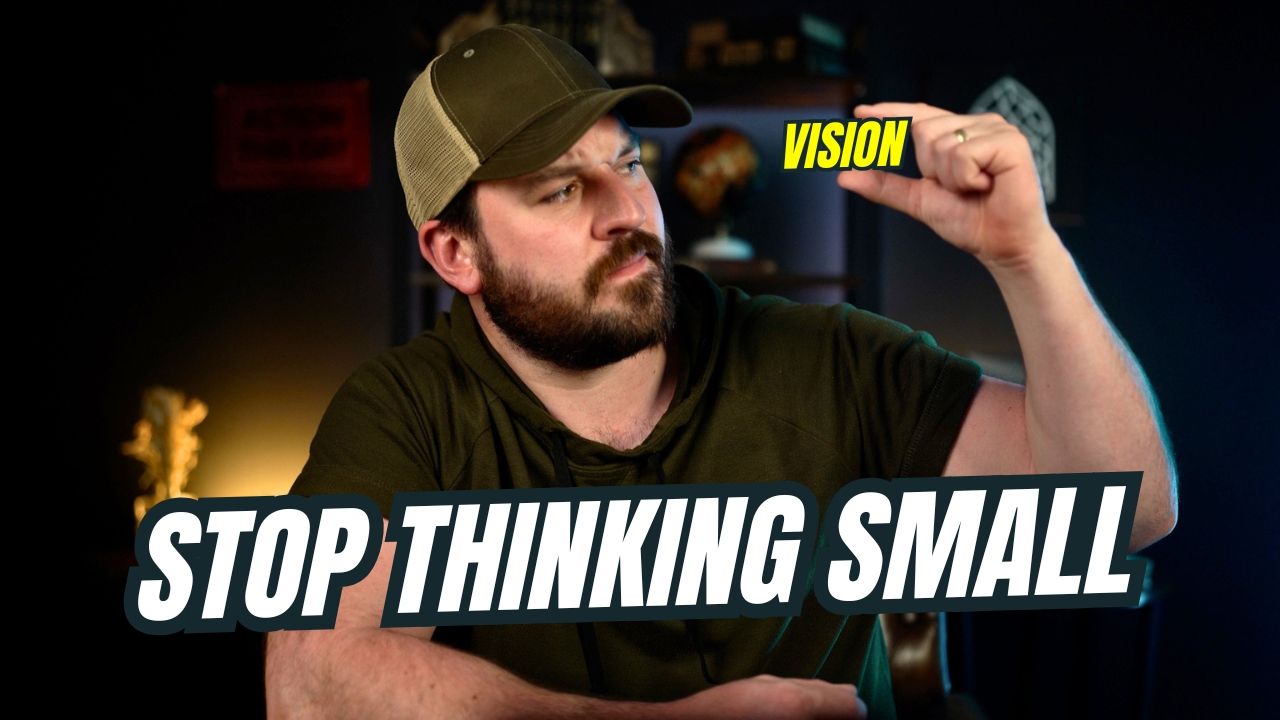
Your Vision Is Too Small | Think The Impossible 🔥
Apr 25, 2026YouTube Version (If You'd Rather Watch 👉) https://www.youtube.com/watch?v=0Jk8C9l3vMM
--
There was a time when the 4-minute mile was considered impossible.
For years, runners, coaches, and even scientists believed the human body simply could not do it.
Four minutes. One mile. That was the wall. The limit. The line no one could cross.
Then came Roger Bannister.
On May 6, 1954, Bannister did what the world had declared impossible: he ran a mile in 3 minutes, 59.4 seconds. He didn’t just break a record — he did the impossible. He challenged a belief that had controlled an entire generation.
And here’s the fascinating part: only 46 days later, another runner broke the 4-minute mile. Then another. Then another. What once seemed unreachable suddenly became repeatable.
In the years that followed, the 4-minute mile went from impossible to expected at the elite level, with hundreds of runners eventually accomplishing it. The current world record stands at 3:43.13.
When someone has the courage to see beyond the limits everyone else accepts, they don’t just change their own outcome—they expand what other people believe is possible, too.
That’s the power of vision.
But not just vision, IMPOSSIBLE vision.
And that’s the question: How big is your vision?
Roger Bannister wasn’t the only one with a vision to do the impossible.
Today, we stand upon the work of countless individuals whose impossible vision became a reality.
I’ve also seen this work firsthand in my own life.
My biggest, most impossible vision for my life became a reality.
I’ll tell you more about that story later, but what I can say is, this stuff is real.
And I’m in the process now of applying these same principles to the next phase of my life.
By the end of this episode, my hope is that you not only understand the power of vision, but you realize your own big, impossible vision.
One that not only changes your life, but might just change the world.
CASE STUDY: AVIATION
As far back as we can look, it seems as though mankind has always dreamed of flying.
We see it as far back as the 5th century BC, where philosophers in Ancient China became fascinated by the notion of flight and invented kites to simulate their observations.
This quickly turned into experiments in rocketry, gliding, tower jumping, and other attempts to explore the world of flight.
During the 1480s, Leonardo da Vinci began his first formal studies of flight, producing over 100 drawings that illustrated his aeronautical theories.
It’s as if humanity has always been looking up at the birds in the sky, wondering if we could ever join them among the clouds.
But that’s impossible, isn’t it?
Centuries passed before someone finally had a vision big enough to say, “It may be impossible, but I have an impossible vision.”
Fast forward to the 18th Century, the Montgolfier brothers successfully demonstrated the first hot-air balloon.
The first free human flight.
The impossible became a reality.
But, wait.
“What if we could actually control and power that flight?”
“Oh, that’s impossible.”
Well, that is exactly the impossible vision that Orville and Wilbur Wright set out to achieve in 1899.
And by 1903, the impossible became reality.
The flight lasted only 12 seconds, yet the world would never be the same.
But again, that realized vision led to yet another impossible vision in aviation.
Forget 12-second flights. What if we could fly across the ocean?
Impossible!
Think again. It only took about 20 years.
On May 20–21, 1927, American aviator Charles Lindbergh completed the first solo, nonstop transatlantic flight, traveling from New York to Paris.
Flying at around 100 MPH, he flew for roughly 33.5 hours, landing to a crowd of 150,000 people.
Again, the impossible became reality.
But what if we couldn’t just control and power flight over long distances, but what if we could enhance performance by, I don’t know, 700%?
What if we could fly faster than the speed of sound?!
What?! That sounds crazy. Dare I say, impossible.
But in 1947, Chuck Yeager proved everyone wrong, becoming the first human to break the sound barrier, piloting the rocket-powered aircraft nicknamed “Glamorous Glennis.”
Speaking of rockets…
What if we took aviation beyond just these terrestrial limits?
What if we could fly to the freakin' moon?!
Impossible?
In September 1962, John F. Kennedy stood before the US Nation and said, “We choose to go to the moon.”
And not just go to the moon, but do so “before this decade ends.”
The challenge was met on July 20, 1969, when Apollo 11 astronauts Neil Armstrong and Buzz Aldrin landed on the Moon, approximately 161 days before the decade ended.
The impossible “One small step for man” really was “One giant leap for mankind.”
It wasn’t just going to the moon; it was showing mankind that an impossible vision can become a reality.
And similar to every other impossible vision before it, the next vision would seem equally impossible.
And here we are now, building reusable rockets and establishing sustainable long-term exploration on the Moon as a "stepping stone" for human missions to Mars or even the wild notion of colonizing Mars.
Who knows what the next “impossible” vision will be, but whatever it is, I hope it’s really, really big.
HISTORY’S LESSON:
I don’t know what industry or sector you’re in, but ask yourself, “Who are the leaders in your field?”
I’m talking about the ones that broke the record, made history, or reinvented what was considered possible.
It’s probably the ones who had the big, impossible vision.
And they built on the big, impossible vision of the leaders before them, who built on the vision of the leaders before them, and so on…
You see, history teaches us an important lesson.
If you want to lead within your generation, like really lead, you need a vision so big and impossible that it’s scary for you to even say it out loud.
We’re talking about a vision so big that it might take 10, 20, or even 30 years to realize.
A vision so big and impossible that it will not only define your life, but it may just change the world!
So, how big is your vision right now?
THE “WE’VE ARRIVED” SYNDROME (MY STORY):
Since I was a kid, I had a big vision.
I remember in the 8th Grade, lying awake at night in my bed, getting lost in what I thought, at the time, was an impossible vision.
I remember all of the details to this day.
I dreamed of getting married, having at least four kids, having a home, and playing board games with my, at the time, imaginary family.
I dreamed of having a ministry where I could pursue all of my passions in a way that served people and had a meaningful impact.
I dreamed of being on a team like the Fellowship of the Ring (Yes, I understand how nerdy that sounds).
I wanted a team that valued loyalty, sacrifice, perseverance, courage, and friendship.
And I imagined that we would do things that could change the world.
You can only imagine how that vision seemed pretty impossible for that 13-year-old version of me.
But I wanted it so bad that it would literally keep me up at night.
What if I never reached it?
What if it wasn’t possible?
I remember, for whatever reason, I put my bed in my closet and painted my closet with that chalkboard paint.
I remember that I would write scriptures on the wall.
It was sort of a vision board for me.
I recently went into my old room at my parents' house.
To my surprise, 20 years later, the closet is still exactly the same.
My parents left every bit of that old vision board intact.
As I looked at it, I had a profound realization.
That impossible dream of that little 13-year-old boy became a reality.
God has given me every single thing in that impossible vision I had 20 years ago.
I sometimes wonder if I had never had that impossible vision, would my life as it is now have become a reality?
Or, as the Bible warns, “Where there is no vision, the people perish.”
If I hadn’t had a vision for my family and ministry at an early age, I think I could have easily taken my life in some pretty destructive directions, directions that wouldn't have given me the life I have today.
Particularly between the ages of 16 and 22.
Gosh, did I dodge some bullets!
I would say the vision for my future was one of the main things that kept me out of trouble.
Now, I tell you my story for two reasons.
First, I feel like I have personal proof of concept.
I had what felt like an impossible vision, and it became a reality in my life.
So, I believe in this stuff.
But the second reason is because of something called the “We’ve Arrived” Syndrome.
You may have heard of Jim Collins and his phenomenal research and writing.
He coined the term BHAG (Big-Hairy-Audacious-Goals).
While the BHAG concept has gained a lot of attention, there’s something else in his work that I think a lot of people miss.
He calls it the “We’ve Arrived” Syndrome.
It’s something that I’m experiencing right now.
Collins writes, “It’s absolutely essential to recognize when you’ve fulfilled a mission and therefore need to set a new one. When a mission has been fulfilled, people will tend to set their own directions and fragment the whole.”
He brings up the classic historical example of the WWII allied effort between Russia, England, and the United States.
The allies worked together remarkably well, sharing the mission to defeat Hitler.
But once Hitler was dealt with, the alliance broke apart, plunging the world into the Cold War.
The same thing can happen at the individual, team, and company levels.
You can become lost, adrift, and aimless once you’ve arrived at your goal.
Collins research shows countless casualties to the “We’ve Arrived” Syndrome.
What would have happened if there had never been another big, impossible vision following the Wright Brothers' 12-second flight?
This is precisely why Kennedy cast the impossible vision of sending a man to the moon.
It wasn’t necessarily because we desperately needed something from the moon.
It was because the United States needed to be challenged.
In his own words, “We choose to go to the moon in this decade and do the other things not because they are easy, but because they are hard. Because that goal will serve to organize and measure the best of our energies and skills, because that challenge is one that we're willing to accept. One we are unwilling to postpone. And therefore, as we set sail, we ask God's blessing on the most hazardous and dangerous and greatest adventure that man has ever gone.”
I recently went to the mountains for a retreat, and the one question that I walked off the mountain with is, “What is the next big, impossible vision?”
What’s crazy is that I already intuitively knew what it was.
I just needed to have my mountain-top moment to seal it in my soul.
It’s scary to say out loud.
And you know what? It might take 30 years to be realized.
I may not even be alive to see it become a reality.
You’re never promised tomorrow.
But you know, Kennedy didn’t live to see his impossible vision of going to the moon become a reality.
That’s not the point.
The point is to have a big, impossible vision because that’s what leaders do.
Where there is no vision, the people perish.
THE BIBLICAL PORTRAIT:
As a Christian, this whole idea of impossible vision goes a lot deeper than just goal-setting.
There’s a spiritual dynamic to this that, as a pastor, I can’t help but bring into this discussion.
If you’ve spent any time at all reading the Bible, you’ll notice a pretty common theme.
God is in the business of big, impossible vision.
God came to Noah with a big, impossible vision: to build a boat.
But not just a boat, a boat so big that it could fit roughly 450 semi-truck trailers on it.
A boat as big as a building.
God came to Abraham and said, “I’m going to make you into a great nation.”
God’s vision seemed so big and impossible that at one point it made Abraham laugh.
“Isn’t that impossible?” Abraham asked God.
God essentially said, “Watch me.”
When God came to Moses, he said, “I want you to lead my people out of Egypt.”
Scholars estimate that there could have been as many as 2-3 million slaves in Egypt at that time.
What does Moses say to God?
He says, “There’s no way!”
“I can’t do that!”
He comes up with pretty much every excuse imaginable for why it’s not possible.
God breaks down every single excuse.
He says, “Oh, it’s possible.”
You know why?
“Because I will be with you.”
“You tell them exactly who sent you, and then sit back and watch the impossible become a reality.”
Sometimes God’s vision for our lives isn’t the one we see coming.
God came to Jonah and told him to go one way, but Jonah went the other.
It took a rather large fish to convince him of God’s vision.
God came to Saul, a previous enemy of God, a persecutor of Christians, and the early church.
God had a bigger vision for Saul’s life.
He changed his name to Paul and gave him an entirely new vision, one way bigger and more impossible.
On and on it goes.
I could give you example after example of God’s vision being big and impossible in the eyes of mankind, and that’s the point.
We weren’t created to think small.
Jesus said, “With God all things are possible.”
We are created in the image of that God.
As a Christian, I see a big, impossible vision as a biblical mandate.
Why would I ever think small if I have the God of the universe behind me?
Why would I want goals that seem “attainable?”
No! I want to unleash the power of God’s vision in my life.
And that starts by inviting God to breathe that vision into me.
I want the vision of my life to be His first and foremost.
I want a vision that has me relying on Him every step of the way.
So let me ask you again, “How big is your vision?”
I hope it feels impossible.
As always, keep fighting the good fight.
I’ll see you again real soon.
GET MY FREE LEADERSHIP RESOURCE LIST
Stay connected with leadership updates!
Join our community to receive the latest content and updates.
We hate SPAM. We will never sell your information, for any reason.