New Leaders Fail Because Nobody Says This
Jul 21, 2026YouTube Version (If You'd Rather Watch 👉) https://youtu.be/L9jmf0CSZH8
I will never forget the first time I was promoted into a leadership position. And it's like there's all these things that nobody tells you. And it's only once you've gone through it that you're like, oh my goodness, I wish I had known this earlier.
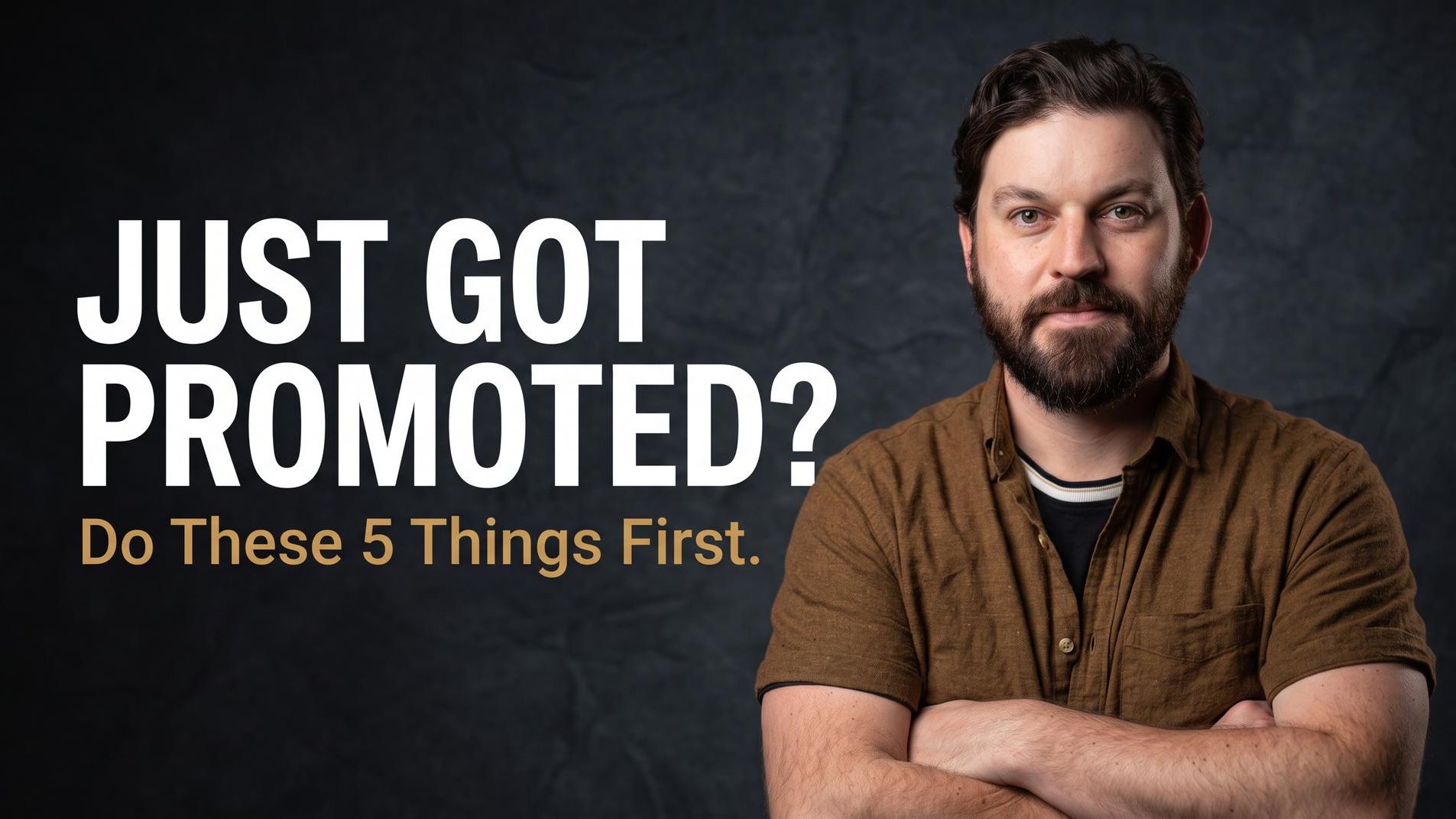
So that's what we're gonna dig into in this video. So if you're new to leadership, I'm gonna give you five things that I think are really gonna help you out.
Which brings me to the first thing you need to know.
#1 Listen before you lead.
Your first instinct as a high achiever is going to be to prove yourself. You're obviously gonna wanna find problems or you're gonna wanna fix them. I get it because I've done it and I've been there, but that's not what you or the team needs right now. Your only job in the beginning is to listen.
You should get one-on-ones on the calendar with every person on your team. If your team is huge, prioritize the key players. And in those meetings, you have two objectives.
First, you need to establish the relationship. The message is simple. I'm here to support you. I'm your advocate. And then second, you need to ask questions that build connection and give you the information that you need. Here are the three that I would recommend.
From your perspective, what's going well right now? This shows respect for what's already been accomplished. Here's the second one.
If you could wave a magic wand, what's the one thing you'd change that would make your life easier or more effective? Or more directly, is there anything bugging you right now? Something about that question unlocks information you desperately need.
And finally, what can I do to serve you? It's so simple, so powerful, it reframes your role entirely. It positions you as a resource, not a boss.
But here's the headline. Really listen with an agenda to understand, not just because it makes them feel valued, which it does, but because your team knows the landscape. Jumping in with solutions before you understand the context is the fastest way to signal that you don't value their input. It screams that I'm just here to be the boss and that is not leadership. So just show them they matter before you show them the mission. Listen to them before you ask them to listen to you.
Now here's the second thing and this is actually harder than it sounds.
#2 You need to change your mindset from doer to developer.
Too often, new leaders think in terms of their skills and they forget that leadership requires a completely different playbook. The skills that made you a rockstar individual contributor, those won't make you a great leader.
Think about it. Your success used to be measured by your output and now your success is measured by your entire team's output and performance. The biggest trap is failing to let go of the doer mindset. Your identity has got to evolve. You have to switch from athlete to coach, from musician to conductor.
Every time a team member comes to you with a problem, you have a choice. Now, the doer instinct is going to say to find the answer for them or just do it yourself. It's faster. It feels efficient. And if we're being honest, it feels good to be the one who can get things done, right? But that's the old habit. And you have to kill that habit.
It's like going to the gym and having your trainer lift all the weights for you. You might learn how the exercise works, but you're not getting any stronger. A leader asks a different question. Instead of how can I solve this? A leader asks who else can solve this?
When someone comes to you for a decision, you learn to ask a different kind of question. You ask, what do you think? And 99% of the time, they have a great answer, maybe even better than yours. And so instead of stepping in to do the work, you take the time to teach them how to do it. You're not a fisherman giving out fish anymore. You're a craftsman making fishing poles, right?
I know this can be really hard because it takes patience and it means accepting that a task might take longer or not be done exactly the way that you would do it. But your role is no longer to be the best player on the team. Your role is to be the coach who develops great players.
Which leads directly to the third thing.
#3 You need to think people, not projects.
This builds on everything we just talked about. Your new job has two parts. First, you get the right people on the bus. Jim Collins, the author of Good to Great, said that the executives who ignited the greatest transformations didn't first figure out where to drive the bus and then find people to take it there. They first got the right people on the bus and the wrong people off the bus, and then they figured out where to drive it. And that's just wisdom right there.
So, get the right people first.
And then the second part is how you invest those people. This is where the identity shift becomes real. It's about the people, not the projects. It's about developing them, not doing the work for them. It's about building the team, not building your reputation.
#4 You need to anchor yourself to mission, vision, and values, not to your own opinions or your own credibility.
Because here's what happens when you lead from mission instead of ego. Your decisions carry weight that your experience can't yet provide. And that's just a fact. That's just reality.
The why behind your choices isn't driven by you. It's driven by the collective pursuit of something bigger. This was huge for me because I was put into leadership at a very young age. And the only thing that got me through that experience was depending on the mission and the vision and the values as my anchoring.
A lot of new leaders feel the pressure to prove themselves and act like they have all the answers. And don't do that. Just cast vision, bring people back to the mission.
You know the old saying, where there is no vision, people perish. So reverse engineer that. Where there is vision, people have life. Vision's like a bucket, right? With a hole in the bottom. It's constantly leaking and you have to keep filling the dang thing up. People forget the vision constantly. And it's the leader's job to keep it alive. Similar to passion, it's a fire that you never let go out.
If you can't articulate the mission, vision, and values, you're in trouble. If your team can't articulate them, you're in trouble. Get laser focused on what the vision is and get really good at articulating it in the most inspiring way that you possibly can. You wanna sneak it into the meetings and you wanna sneak it into the coffees and the emails. You wanna also have moments where you're screaming it from the rooftops. You wanna plaster it on the walls. There's really no such thing as too much vision casting.
#5 The heart of leadership.
I wanna tell you a story that will hopefully make this one stick.
There's a young professional walking home late after work one night and his phone had died. The trains were delayed. And so he took a shortcut through this dark back street. And halfway down the block, a group swarmed him and took his wallet, took his laptop, took his coat. They beat him up really badly and they left him near an alley entrance, just lying there with these serious injuries.
A few minutes later, a well-known leader in the area walked by and he saw the man on the ground and he crossed to the other side of the street and just kept walking. Not long after that, another person came down the same street. It was a woman who led at a nearby church, and she noticed the injured man too, and she was worried about him. But she also crossed the street and kept going, and she thought to herself, you know, I hope someone helps him. But she didn't do anything.
Finally, a delivery driver came by. He was an immigrant from a country many people in that city looked down on. His accent was mocked. His neighborhood was avoided. People treated him like he didn't belong. But when he saw the injured man, he stopped. And he got off his bike and knelt beside him.
He called emergency services, and he took off his own jacket to keep the man warm. He stayed with him until help arrived. He rode along to the hospital with him. He gave the nurse his own contact information and said, "Hey, if he needs help getting home, you call me." He left money so that the man could get food and a ride.
The next day, the injured man woke up and asked who had helped him. The nurse said, "It was the delivery driver. I don't think he even knew you," she said. "He just refused to leave you all alone. He saved your life."
Now, if that story sounds familiar to you, it might be because it is. It's actually the story of the Good Samaritan, just, I guess, with a little modern spin on it. But the leadership takeaway is the same, and it's always been a powerful one for me.
You see, the hero was not the person with the title, not the person with the reputation, not the person with the platform. The hero was the one who showed compassion in action. The hero was the Good Samaritan who had no position, no recognition, yet demonstrated true leadership by noticing a need, taking responsibility, and acting with courage.
Great leaders don't ask, "Is this my problem?" No. They ask, "What can I do to help?" Leadership isn't proven by status or public image. It's proven by something deeper.
Leadership isn't about receiving. It's about giving.
It's about dying to ourselves for a greater good.
True leadership is selfless.
True leadership is sacrifice.
I'm rooting for you, I'm praying for you, and I cannot wait to see what God does in your leadership.
As always, keep fighting the good fight.
GET MY FREE LEADERSHIP RESOURCE LIST
Stay connected with leadership updates!
Join our community to receive the latest content and updates.
We hate SPAM. We will never sell your information, for any reason.